This service is the right entry point if:
You have a product, prototype, or concept that isn’t ready to photograph — but you need to present it professionally to a buyer, investor, or event audience right now.
You’re showing at a trade show, presenting to investors, or launching to market, and the asset that represents your product doesn’t exist yet or doesn’t meet the standard the event requires.
Your current renders or product visuals look like early-stage placeholders — and your business has moved past that stage. The gap between what you’re showing and what you’re selling is working against you.
You operate in a technical or regulated industry — defense, IoT, security, infrastructure, industrial equipment — where accuracy and environmental context matter as much as visual quality.
This is probably not the right fit if you need a quick product photo edit, a simple mockup, or a Canva-style render. QDS works at the systems level — visualization built for a specific business context, output requirement, and deployment surface. If you’re not yet sure how the asset will be used, Start a Project first.
A render without context is just a picture.
Most 3D visualization work produces a file. A technically accurate model, rendered clean, exported. What it doesn’t do is communicate — what the product does, how it operates in the environment it was built for, what the viewer needs to understand, believe, or decide after seeing it.
QDS builds visualization as a communication asset. Every brief starts with the same question: what does this need to make the viewer understand or do? The model is built backward from that answer. The render format, the environment, the scale, the level of detail — all of it is determined by the deployment context, not by aesthetic preference.
The result is a visual that works in the room it’s being shown in, not just on a screen.
Standard 3D render
- Starts with the model
- Delivers files
- Prioritizes technical output
- Often lacks launch or sales context
- Creates a standalone visual
QDS system approach
QDS visualization
- Starts with what the viewer needs to understand
- Delivers communication assets
- Balances accuracy with presentation context
- Built for pitches, trade shows, websites, and launches
- Connects the visual to the business message
What a 3D visualization engagement produces
Five phases. Defined deliverables at each. Built for the specific context you’re presenting in.
Brief
Context, use case, output requirements, and technical parameters. We need to know where this is going and who’s in the room before we build anything. The brief is the entire engagement — everything else executes against it.
You leave with: Approved visualization brief — format, scale, environment, and deployment specs confirmed.
Reference + Concept
Reference gathering, concept direction, and initial composition. Establishes the visual approach, camera angle, and environmental context before detailed modeling begins. One round of concept feedback before proceeding.
You leave with: Approved concept direction — composition, environment, and lighting approach confirmed.
Modeling
3D model build to the technical and dimensional specifications of the brief. For product visualization: built to CAD specs or dimensional reference. For environments: built to architectural or spatial specifications.
You leave with: Approved 3D model — reviewed for accuracy and context-fit before rendering begins.
Render + Lighting
Final rendering, lighting, materials, and post-processing. Output in formats required for each deployment surface. Revisions at this stage are scoped in the brief — not open-ended.
You leave with: Final rendered assets in all required formats and sizes.
Delivery Package
Organized delivery of all assets with usage notes, format specifications, and file structure. Ready to hand to a printer, a developer, a conference AV team, or an investor deck designer without translation.
You leave with: Full asset package — named, organized, and deployment-ready.
Timeline depends on scope and complexity. A focused single-product visualization can be delivered in 3–4 weeks from brief approval. Complex environments or motion work take longer. We’ll confirm feasibility at the brief stage — not after work has begun.
Questions we get before the first conversation
The product is still changing. Should we wait?
Not necessarily. If the core form factor or concept is established, we can build to the current spec and update as the design evolves. Waiting until the product is final often means missing the event or pitch deadline you needed the visualization for in the first place.
Can you work from CAD files or technical drawings?
Yes. If CAD files or dimensioned drawings exist, we use them as the modeling reference. If they don’t, we work from product briefs, physical prototypes, or reference materials you can provide. The brief stage clarifies what’s available and what we need to build from.
We need this for a trade show in 6 weeks. Is that feasible?
Depends on scope and complexity. A focused single-product visualization for a specific deployment surface can be delivered in 3–4 weeks from brief approval. Complex environments or multi-product systems take longer. We’ll tell you directly at the brief stage whether the timeline is feasible — not after we’ve started.
What format do we get the files in?
We deliver in the formats your deployment requires — print-ready TIFF/PNG at required DPI, web-optimized JPEG/WebP, presentation-ready formats, and video/animation files if motion is in scope. All format requirements are captured in the brief. You won’t receive a package of files with no guidance on how to use them.
Can you animate the visualization?
Yes, if motion is scoped in the brief. Product animations, walkthroughs, and event loop content are available. Motion work extends the timeline and is priced separately from static renders. If you know you need animation, flag it at the brief stage — it affects the modeling approach.
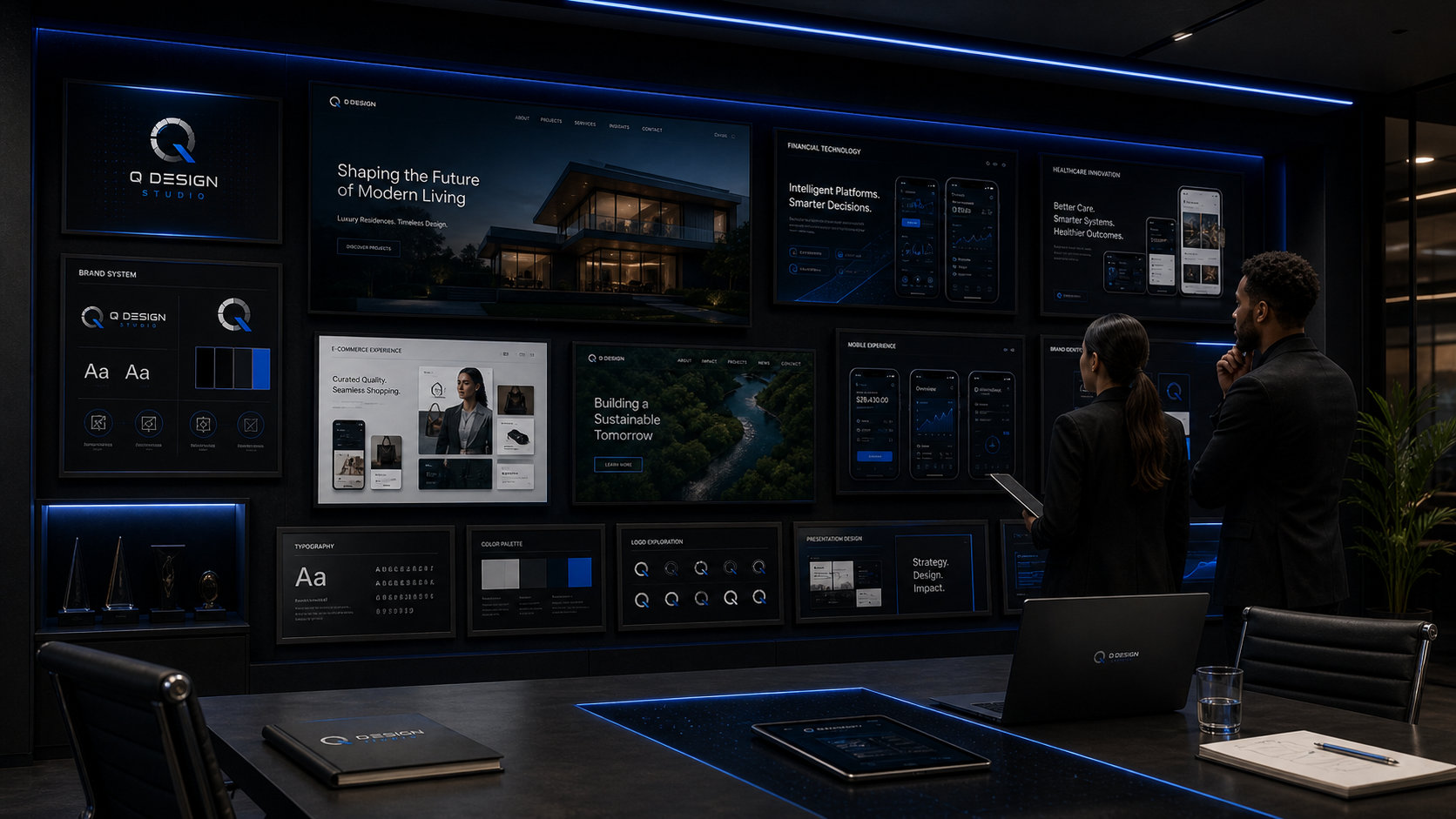
Visual proof for products, environments, and pitch moments
Portfolio and case-study visuals that show how concepts can become presentation-ready assets.
Ready to show what doesn’t exist yet?
Every engagement starts with a brief — a structured conversation about what needs to be shown, where it’s being shown, and what the viewer needs to understand after seeing it. No modeling until we know the answer to those questions.
No commitment required. The brief is where we figure out whether scope, timeline, and budget align.